
Tempered Glass Windows: A Homeowner’s Guide
Tempered glass is one of the most important safety features in modern homes. Learn how it is made, why it is stronger, where it is used, and what homeowners should know before cleaning or maintaining it.
How Tempered Glass Is Made
Tempered glass goes through a controlled heating and cooling process. The glass is first cut to size, then the edges are smoothed and polished. After cleaning, the glass is heated to high temperatures and rapidly cooled with air.
This rapid cooling process creates compression on the outer surfaces and tension inside the glass. That balance is what gives tempered glass its strength.
Why Tempered Glass Is Stronger
The strength of tempered glass comes from surface compression. During rapid cooling, the outside of the glass cools faster than the inside. This puts the outer surface into compression and the inner core into tension.
This structure helps the glass absorb and spread stress across the pane instead of breaking easily under pressure.
Surface Compression & Internal Tension
The outside surface acts like a protective shell. The inside core carries tension. Together, they create a balanced structure that makes tempered glass much stronger than standard glass.
- Outer surface: compression
- Inner core: tension
- Improved impact resistance
- Better safety performance
- Stronger under everyday stress

What Is Tempered Glass?
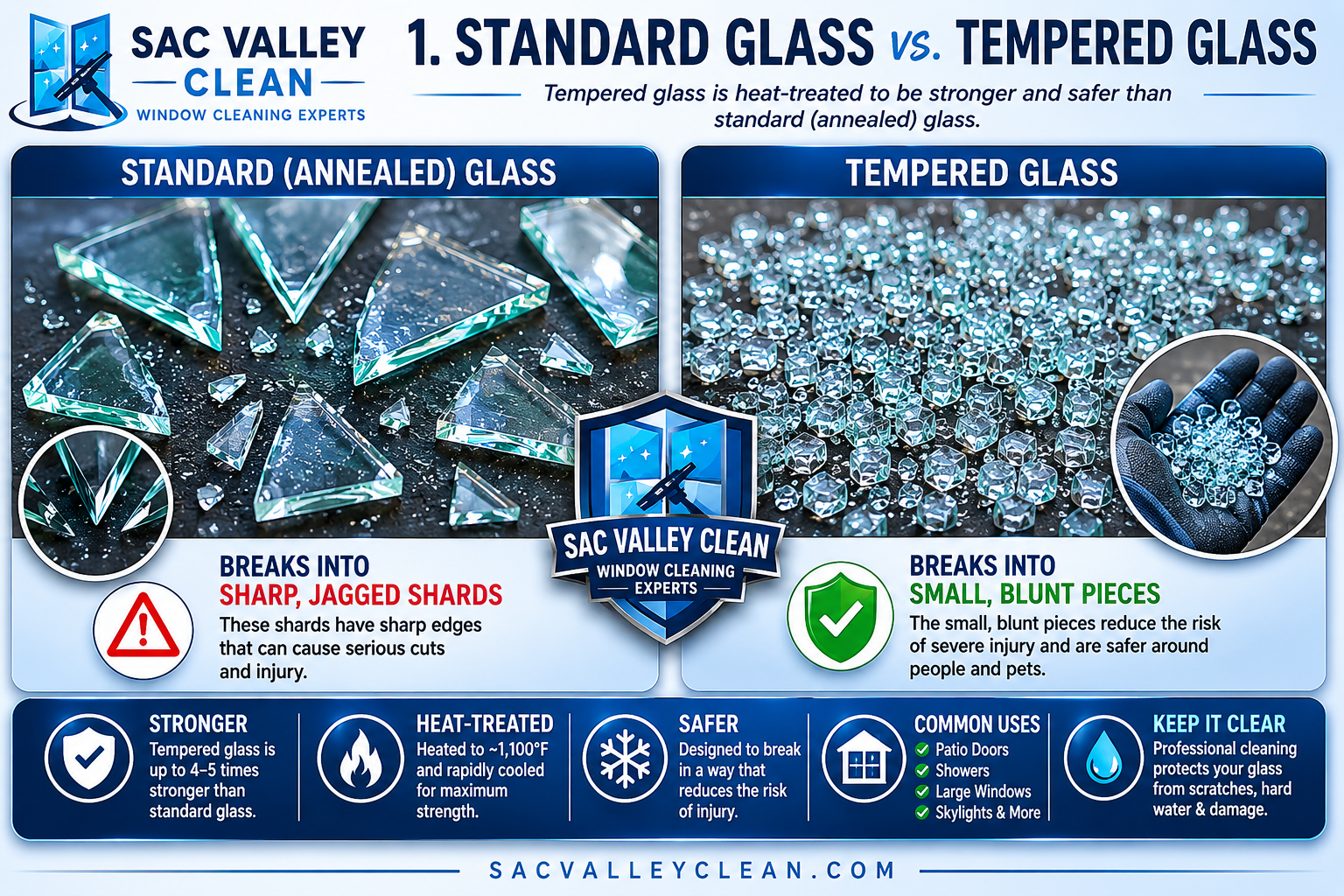
Tempered glass is a type of safety glass that has been heat-treated to make it stronger than standard annealed glass. Instead of breaking into large sharp pieces, tempered glass is designed to break into small, blunt pieces that reduce the risk of serious injury.
This is why tempered glass is commonly used in patio doors, shower doors, large windows, stair areas, skylights, and other places where safety matters.
Why Homeowners Should Understand It
Many homes in Sacramento, Folsom, Roseville, and El Dorado Hills contain tempered glass, but most homeowners do not know where it is located or how it should be cleaned.
- Stronger than standard glass
- Designed for safety
- Used in high-risk areas
- Can still scratch if cleaned improperly
- Often found in modern energy-efficient windows
Tempered Glass Is Stronger — But Not Scratch-Proof
One common misunderstanding is that stronger glass cannot be scratched. Tempered glass is designed to resist impact and break safer, but the surface can still be damaged by abrasive debris, construction dust, hard water minerals, or improper scraper use.
Where Tempered Glass Is Commonly Used
Tempered glass is often required or recommended in areas where people are more likely to come into contact with glass.
- Sliding patio doors
- French doors
- Shower doors and tub enclosures
- Large windows near floors
- Stairways and landings
- Skylights and overhead glass
How to Identify Tempered Glass
Most tempered glass has a small etched stamp in one corner. The stamp may say “Tempered,” “Safety Glass,” “ANSI,” “CPSC,” or include a manufacturer marking.
This mark helps homeowners and professionals identify safety glass before cleaning, repairing, or replacing it.
Tempered Glass & Residential Window Cleaning
Tempered glass can be safely cleaned, but it should be handled with care. This is especially important for residential window washing, residential window cleaning, and exterior glass maintenance in areas with dust, hard water, and sprinkler overspray.
Homeowners in Folsom, Roseville, and El Dorado Hills often deal with large modern windows, patio doors, and hard water exposure. Knowing the glass type helps prevent damage.
- Use plenty of water or cleaning solution
- Avoid dry wiping dusty glass
- Use clean tools
- Be cautious with construction debris
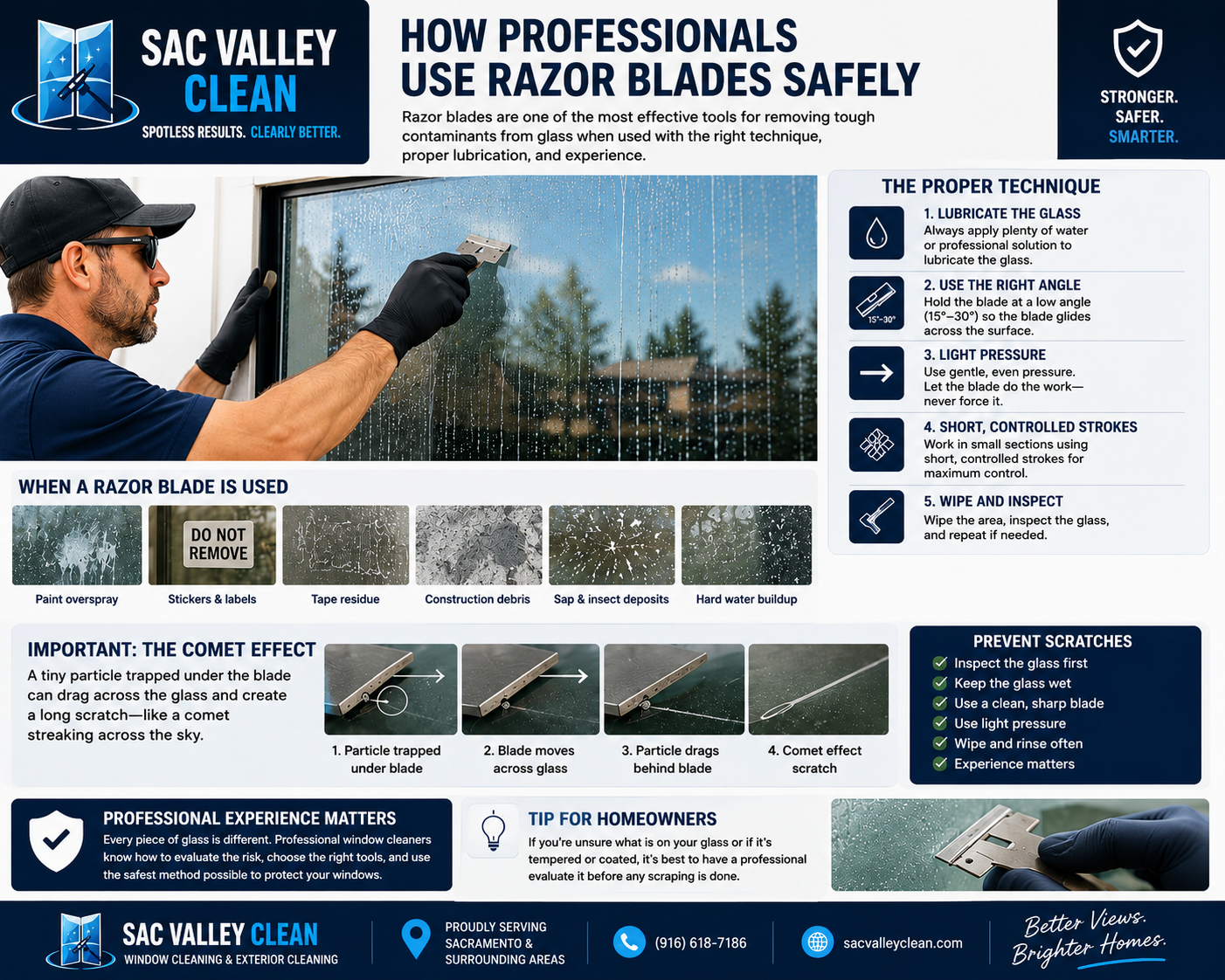
- Inspect the glass before using a scraper
Can Razor Blades Be Used on Tempered Glass?
Professional window cleaners sometimes use razor blades to remove paint overspray, stickers, tape residue, sap, or construction debris from glass. When used correctly, a scraper can be an effective tool.
However, razor blades should be used carefully. The risk is not always the blade itself — it is often what gets trapped under the blade. Tiny particles of sand, concrete dust, metal, paint, or fabrication debris can scratch the glass if dragged across the surface.
Hard Water & Tempered Glass
Hard water can damage tempered glass just like other glass surfaces. Sacramento-area sprinkler overspray, irrigation, pool water, and hose water can leave mineral deposits behind.
If those minerals sit too long, they can bond to the surface and become difficult to remove.
Related guide: Hard Water Stains on Windows.
Tempered Glass & Energy Efficiency
Modern windows may combine tempered glass with Low-E coatings, insulated glass units, argon gas fills, and warm edge spacers. These systems improve comfort, safety, and efficiency.
Learn more in our Energy Efficient Window Guide.
Visual Guide To Tempered Glass
These diagrams help homeowners understand why tempered glass is different from standard glass, how it is manufactured, and why proper cleaning techniques matter.
Common Questions Homeowners Ask About Tempered Glass
Is tempered glass stronger than regular glass?
Yes. Tempered glass is commonly described as several times stronger than standard annealed glass because of the heating and rapid cooling process.
Can tempered glass still scratch?
Yes. Tempered glass resists impact better than regular glass, but the surface can still be scratched by abrasive debris, dirty tools, hard minerals, or improper scraping.
Can tempered glass be cut?
No. Tempered glass cannot be safely cut after it has been tempered. It must be cut to size before the tempering process.
Why does tempered glass break into small pieces?
The internal stress pattern created during tempering causes the glass to break into small blunt pieces instead of large sharp shards.
How do I know if my window is tempered?
Look for a small etched stamp in the corner of the glass. It may say “Tempered,” “Safety Glass,” “ANSI,” or include a manufacturer code.
Is tempered glass common in residential windows?
Yes. Tempered glass is commonly used in residential windows and doors near floors, bathrooms, stairways, patio doors, skylights, and other safety-sensitive areas.
Helpful Related Guides
Upcoming Blog: The Comet Effect

One of the most misunderstood topics in the window cleaning industry is how scratches actually occur on glass.
Many homeowners assume the razor blade causes the scratch. Surprisingly, the blade itself is often not the problem.
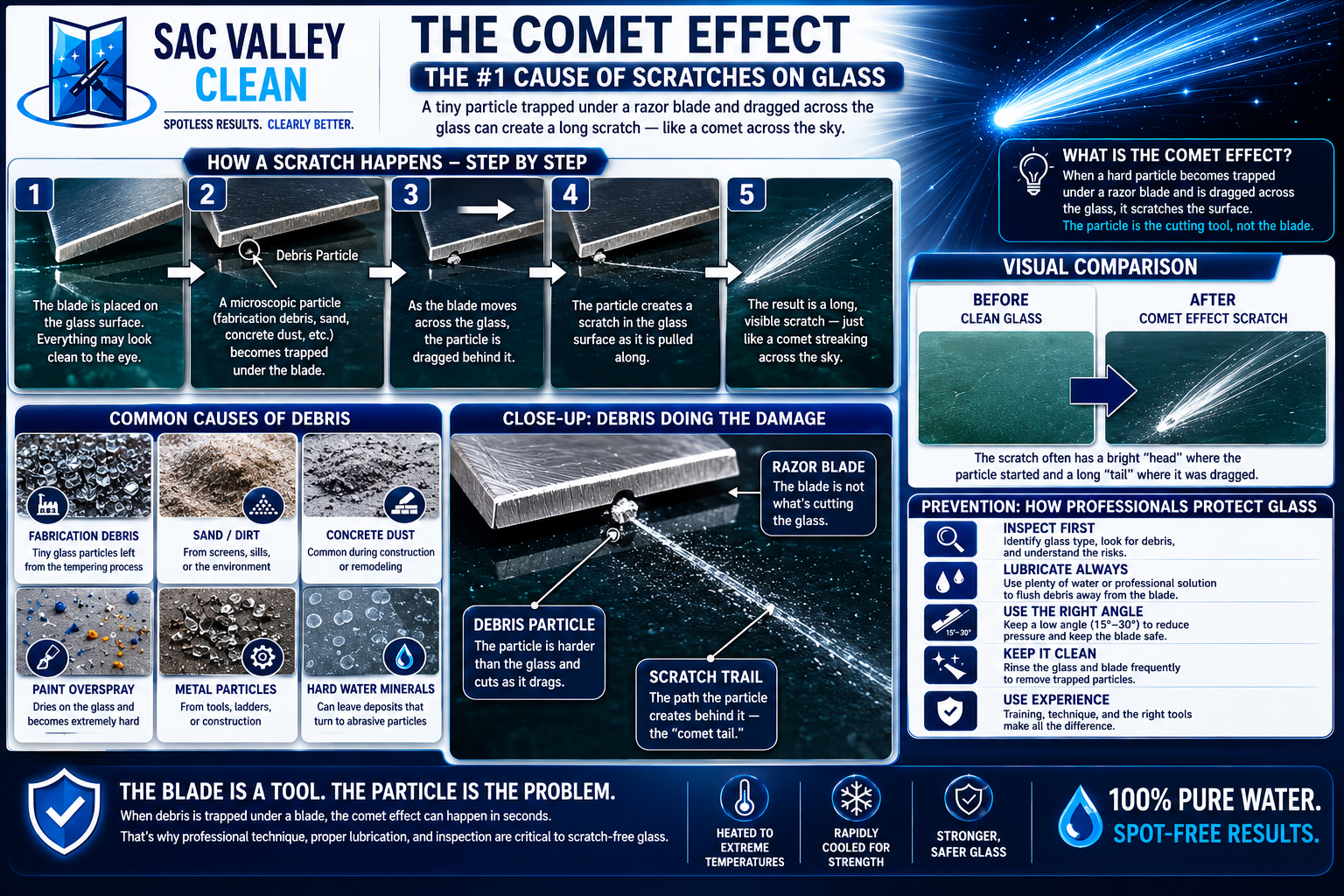
The real danger can be microscopic particles trapped underneath the blade. These particles may include fabrication debris, concrete dust, sand, paint overspray, metal particles, or construction contaminants.
As the blade moves across the glass, the trapped particle drags behind it, creating a long scratch trail. Industry professionals often refer to this phenomenon as the Comet Effect because the scratch pattern resembles a comet streaking across the night sky.
A scratch can occur even when using a brand-new razor blade if a hard particle becomes trapped between the blade and the glass surface.
Our upcoming homeowner guide will explore fabrication debris, why tempered glass can be vulnerable to scratches, proper razor blade technique, when scraping should be avoided, and how professional window cleaners evaluate risk.
Need Help Caring for Modern Windows?
Sac Valley Clean helps Sacramento-area homeowners maintain glass safely with professional window cleaning methods.
Call or Text: 916-844-8622